


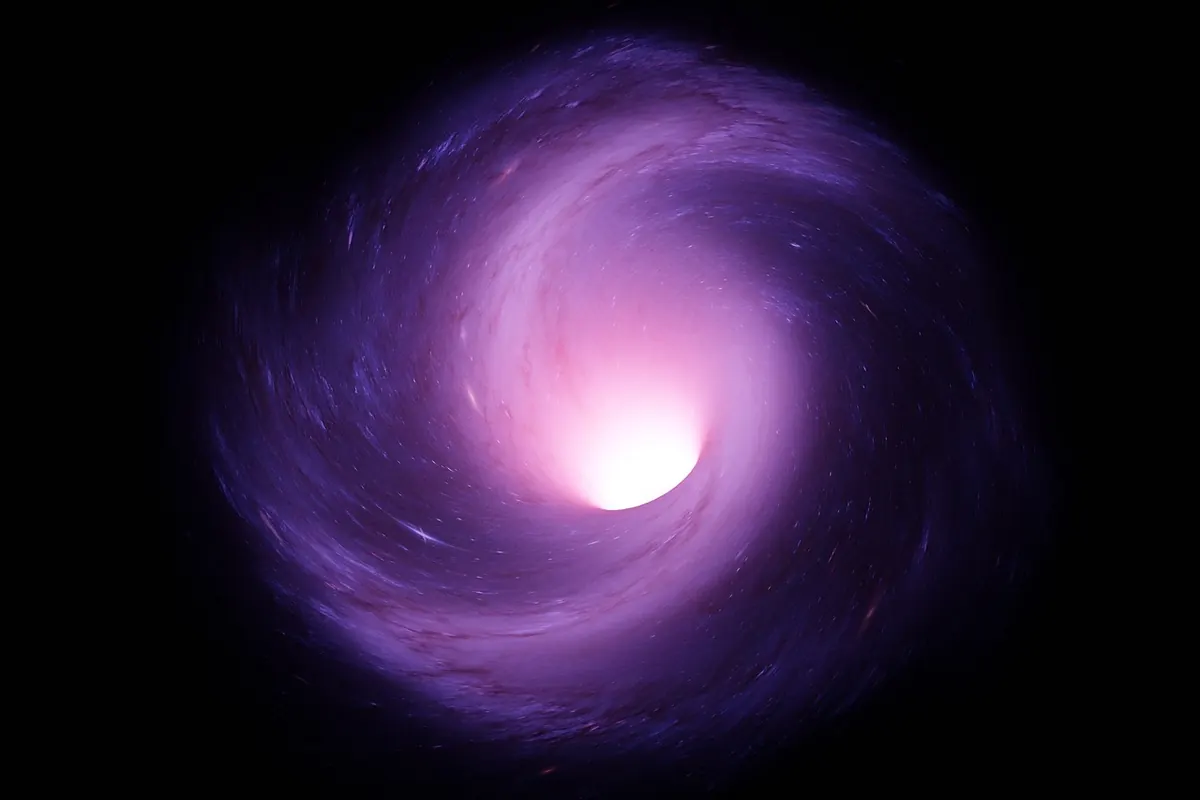
Black holes get more headlines than anything else in astronomy, and more nonsense written about them than most. They are not cosmic vacuum cleaners. They are not doorways to other galaxies. What they are is stranger, and in a quiet way more impressive: regions of space where gravity has won so completely that nothing can climb back out — not matter, not light.
Here is what is actually going on.
Gravity, concentrated
Gravity gets stronger the closer you are to mass, and the more mass is packed into a small space. A black hole is what happens when enough mass ends up in a small enough volume. Around it, escape velocity — the speed you would need to leave and never return — rises above the speed of light. Since nothing travels faster than light, nothing gets out.
Size is the odd part. A black hole with the mass of the Sun would have a radius of roughly three kilometres. Squeeze the Sun into a small town and you have one. The black hole at the centre of the Milky Way is millions of times more massive, but so is its reach.
The event horizon: the point of no return
The event horizon is the boundary where escape becomes impossible. It is not a surface, a wall or a membrane you would feel. Cross it and you would notice nothing at the time — no bump, no flash, no alarm.
The best everyday picture is a river heading for a waterfall. Far upstream, you can swim against the current. Closer in, the water speeds up. Past a certain point, no matter how hard you swim, the current carries you over the edge. The event horizon is that point — except the current is spacetime itself, and the fastest swimmer physics allows is light.
The event horizon is not a thing you hit. It is a place where the rules about escaping stop being optional.
From outside, something odd happens. Because light from a falling object is stretched and delayed, an observer never quite sees it cross. It appears to slow, redden and fade. The object is gone; the image lingers.
What about the singularity?
Inside the horizon, general relativity predicts the mass is crushed into a point of infinite density — the singularity. Treat that with caution. A prediction of infinity usually means the theory has run out of road, not that a real object looks like that. Describing the centre properly would need a tested theory combining gravity with quantum mechanics, and nobody has one yet.
So the event horizon is well understood and observed indirectly. The singularity is a placeholder.
How black holes form
Not all at once, and not all the same way.
- Stellar black holes. A star many times the mass of the Sun runs out of fuel, its core collapses, and the outer layers blast away in a supernova. If enough mass remains in the core, nothing can hold it up.
- Supermassive black holes. These sit at the centres of most large galaxies, including ours. How they grew so big so early is still debated. Mergers and long spells of feeding are leading ideas, not settled answers.
- The awkward middle. Some black holes fall between the two size classes, and a few candidates look oddly light. The catalogue is still being built.
Five myths worth dropping
- "Black holes suck everything in." They do not hoover up the universe. From a distance, a black hole's gravity is the same as any object of the same mass. If the Sun were swapped for a black hole of identical mass, Earth would keep orbiting as before — just in the dark.
- "They are invisible, so we cannot find them." We rarely see the hole itself. We see its effects: stars whipping around unseen mass, gas heated to millions of degrees, jets, and gravitational waves from mergers.
- "They are portals." Falling in does not lead anywhere useful. Tidal forces stretch anything crossing the horizon of a stellar black hole into a long thin strand — astronomers really do call it spaghettification.
- "They last forever." Stephen Hawking showed that black holes slowly radiate energy and shrink. For a stellar-mass hole this takes far longer than the current age of the universe.
- "They would eat the galaxy." A black hole's pull does not grow just because it is a black hole. It only gains mass from what falls in, and most things are in stable orbits.
How we actually see them
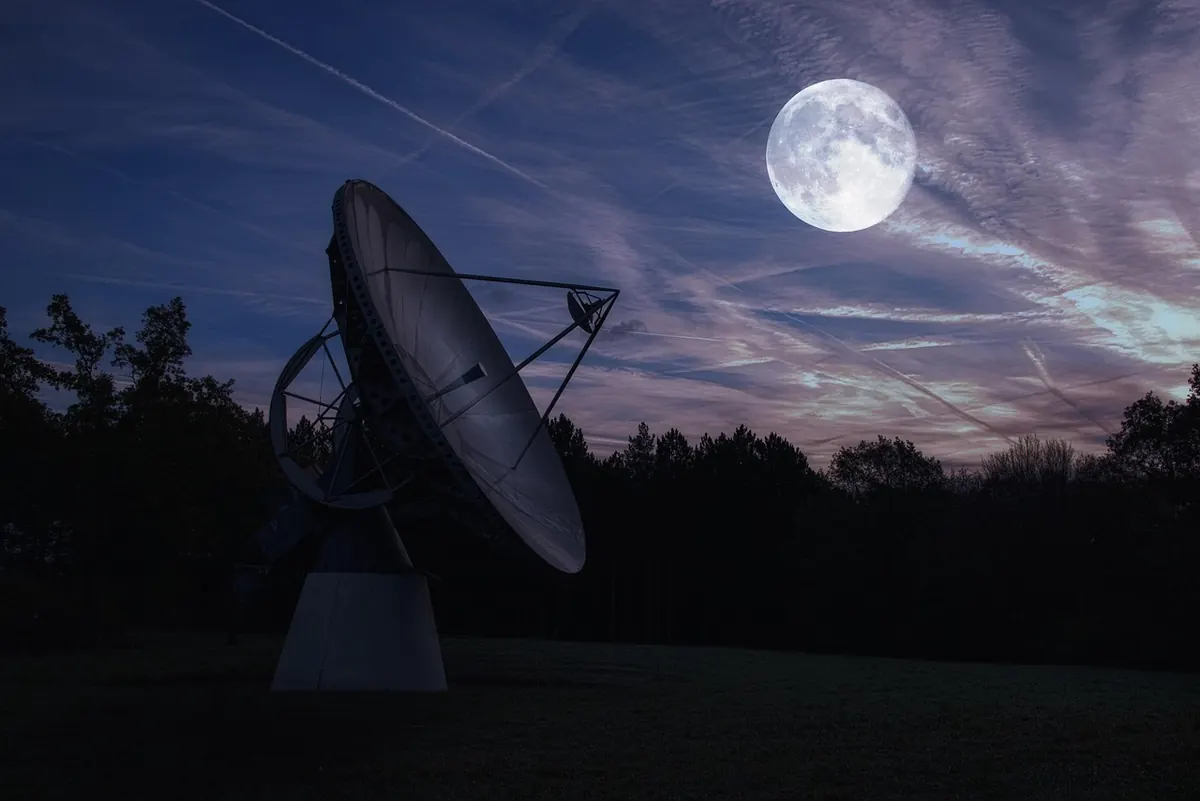
Not with ordinary telescopes. Radio dishes across the planet can be linked to act as one enormous instrument — that is how the Event Horizon Telescope produced the first image of a black hole's surroundings in 2019, and an image of the one at the centre of our galaxy a few years later.
Gravitational-wave detectors are the other route. When two black holes merge, they shake spacetime, and instruments on Earth can measure that ripple. The first detection, announced in 2016, confirmed a prediction made a century earlier.
The hole stays unseen. Almost everything we know comes from its edges.
A practical way to read black hole headlines
Space stories move fast, and black hole coverage often outruns the evidence.
- Ask what was measured. An image of glowing gas, a wobble in a star's orbit or a gravitational-wave signal are all real evidence. "Scientists say" is not.
- Check the word "confirmed". Most results are consistent with a model, which is not the same as proof.
- Be wary of any claim about travelling through a black hole, escaping one, or using one as an energy source. That is fiction, however confidently it is written.
- Remember the scale. The numbers are so large that ordinary intuition fails, and that is exactly where bad reporting creeps in.
Black holes are worth the effort because they sit at the edge of what physics can currently describe. You do not need the equations to follow the story — just a clear picture of gravity, a boundary, and a great deal of patience from the light.
Photo: AlexAntropov86 / Pixabay