

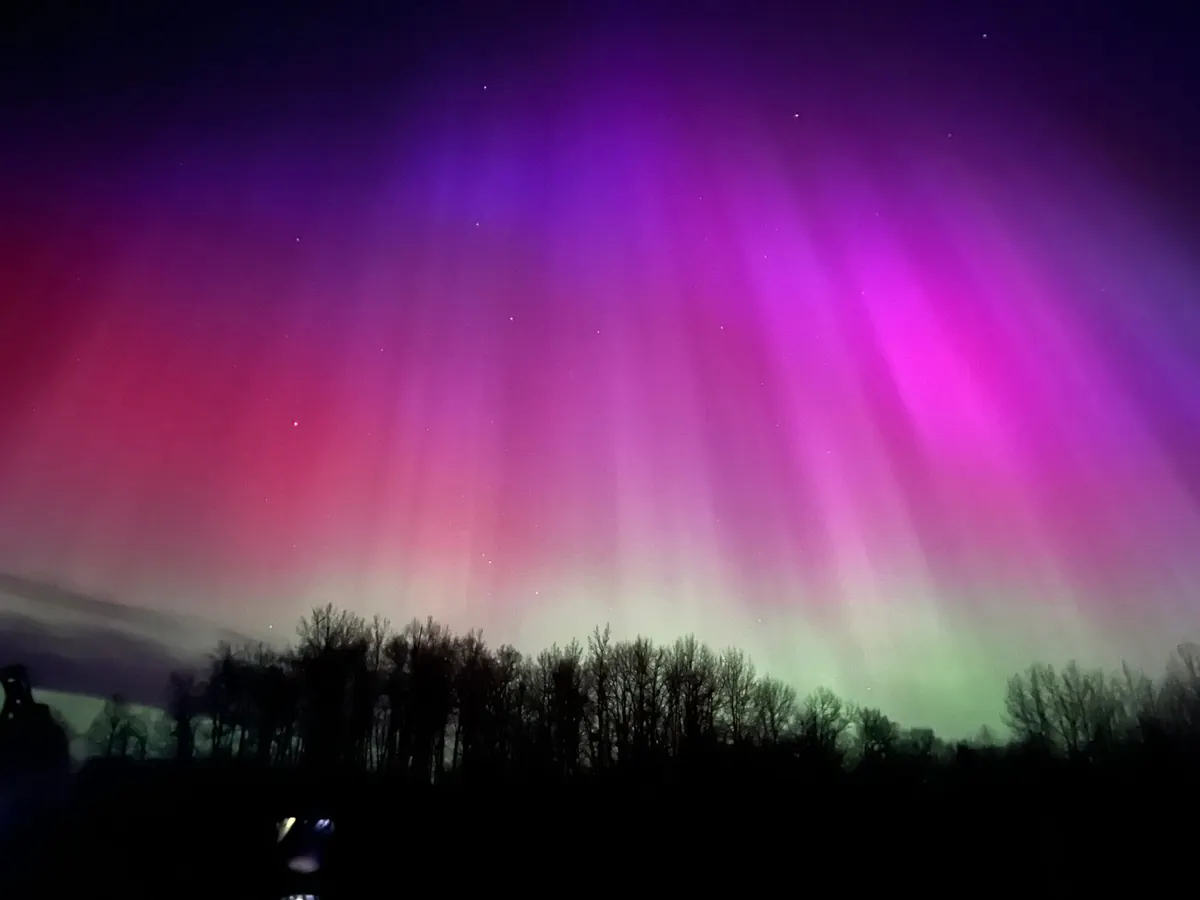
If you have ever stood on a Scottish beach after midnight and watched a pale green band brighten into something that ripples, you already know why aurora chasing becomes a habit. You also know how much of it comes down to luck. The encouraging part is that a good deal of that luck can be engineered: with a sensible forecast, a well-chosen spot and a camera ready before anything happens, a vague hope turns into a decent chance.
The months from September to March are aurora season here, simply because the nights are long enough. Geomagnetic activity also tends to rise around the equinoxes in late September and late March, so the edges of the season often deliver the best displays. The current solar cycle is past its peak but far from quiet, which means coronal holes and the occasional Earth-directed eruption can still keep skywatchers up late.
What actually has to happen
Aurora begins with charged particles streaming away from the Sun — a solar wind that is fast, dense, or both. What matters next is the orientation of the interplanetary magnetic field carried along with it. When that field turns southward, it couples efficiently with Earth's magnetic field, energy pours into the polar regions and the auroral oval expands towards the equator. If it stays northward, the same solar wind can wash over us with barely a flicker.
Once the coupling is strong enough, the oval stretches far enough south to cover Scotland, then northern England, then — on the biggest storms — Wales, the Midlands and even the south coast. Storms are graded from G1 (minor) to G5 (extreme), and each step south becomes rarer.
Reading the Kp index without being fooled by it
Kp is the number most people see first: a 0-9 scale describing how disturbed the magnetic field has been over three-hour windows. It is useful, but it is a planetary average, so it smooths out detail and lags behind what is happening overhead. Roughly speaking, for UK observers:
- Kp 4: Shetland and the far north of Scotland may catch a faint glow low to the horizon.
- Kp 5-6: The classic range for Scotland and Northern Ireland, with good displays from dark sites; northern England has a fighting chance.
- Kp 7: Wales, northern England and parts of the Midlands come into play. North-facing coasts and dark moorland are the places to be.
- Kp 8-9: Rare, but capable of pushing the aurora into southern England. Cameras will see colour that your eyes may read as grey.
Treat that list as a guide rather than a guarantee. A forecast Kp of 8 that never arrives is common, and a modest Kp 5 with a stubbornly southward field can put on a better show than the numbers suggest.
Beyond Kp: the numbers worth checking
Experienced chasers look at three things alongside Kp. The Bz value tells you the north-south orientation of the interplanetary field — negative is what you want, and an hour or two of sustained negative Bz is often the real trigger. Solar wind speed above roughly 500 km/s suggests a high-speed stream from a coronal hole, which can produce recurring activity roughly every 27 days as the Sun rotates. Density matters too: a dense, slow stream can be as effective as a fast, thin one.
An aurora oval map is more useful than Kp alone, because it shows the predicted extent of the oval rather than a single global figure. AuroraWatch UK, run from Lancaster University, issues alerts drawn from magnetometer readings at UK observatories — a helpful reality check when a forecast is marginal. Space weather services publish raw solar wind data within minutes of it arriving.
Where to stand
You need three things: a clear northern horizon, dark skies and a cloud-free forecast. Light pollution to the north is the most common reason a promising night disappoints, so check a map and find the darkness in the direction you will be facing.
Reliable territory includes the far north of Scotland, Shetland, Orkney, the Western Isles and the Moray coast. Further south, Northumberland and the Kielder area, Galloway Forest, the North York Moors, Snowdonia and Exmoor all offer dark northern horizons. On the biggest storms, Norfolk and Suffolk beaches and the Cornish coast can deliver, though expectations should be modest: a faint arc low on the horizon is still a result.
Take the forecast as an invitation, not a promise. Go out, get comfortable, and be there when it happens — most good displays are seen by people who were already standing outside.
A word on safety: remote car parks, sea walls and cliff paths are unforgiving in the dark. Take a red torch, tell someone where you are going, check tide times if the plan involves a beach, and dress for a long wait rather than a quick look.
Camera settings that work
Your eyes are poor at colour in the dark; a camera is not. Set up before you need it, then work through this:
- Tripod and manual mode. Anything handheld will be blurred. Switch off image stabilisation if you can.
- Aperture wide open. f/2.8 or faster. If your lens is f/4, use it, but expect to push the ISO higher.
- ISO 1600-3200. Start at 1600 and raise it if the display is faint, rather than stretching the shutter.
- Shutter speed 5-15 seconds. Longer turns stars into trails; shorter risks a dark, grainy frame. Wide lenses tolerate longer exposures.
- Focus manually at infinity. Use live view, point at a bright star and adjust until it is a pinpoint rather than a blob. Tape the focus ring if it slips.
- Shoot RAW and set white balance around 3500-4000K, adjusting later. Take a test frame, check the histogram, then refine.
- Protect the battery. Cold drains it quickly, so carry a spare in an inside pocket and let the camera acclimatise to avoid condensation on the lens.
Phones can work surprisingly well. Use night mode, brace the handset against something solid and hold still for the full exposure. If a green smudge appears where you saw only grey, you have caught it.
A routine for the season ahead
Check forecasts in the afternoon, but accept that space weather is a short-range business — the most useful updates arrive only a few hours ahead. Pick a site you already know in daylight, arrive before dark, and stay into the early hours; activity often peaks within an hour or two of local midnight. Keep a simple log of dates, conditions and what you saw, and you will soon learn which setups work for your part of the country.
Above all, go out for the sky rather than the trophy shot. A clear night under the stars is not a wasted trip, and the nights when the aurora does arrive will be the ones you remember for years.
Photo: Pexels User / Pexels