

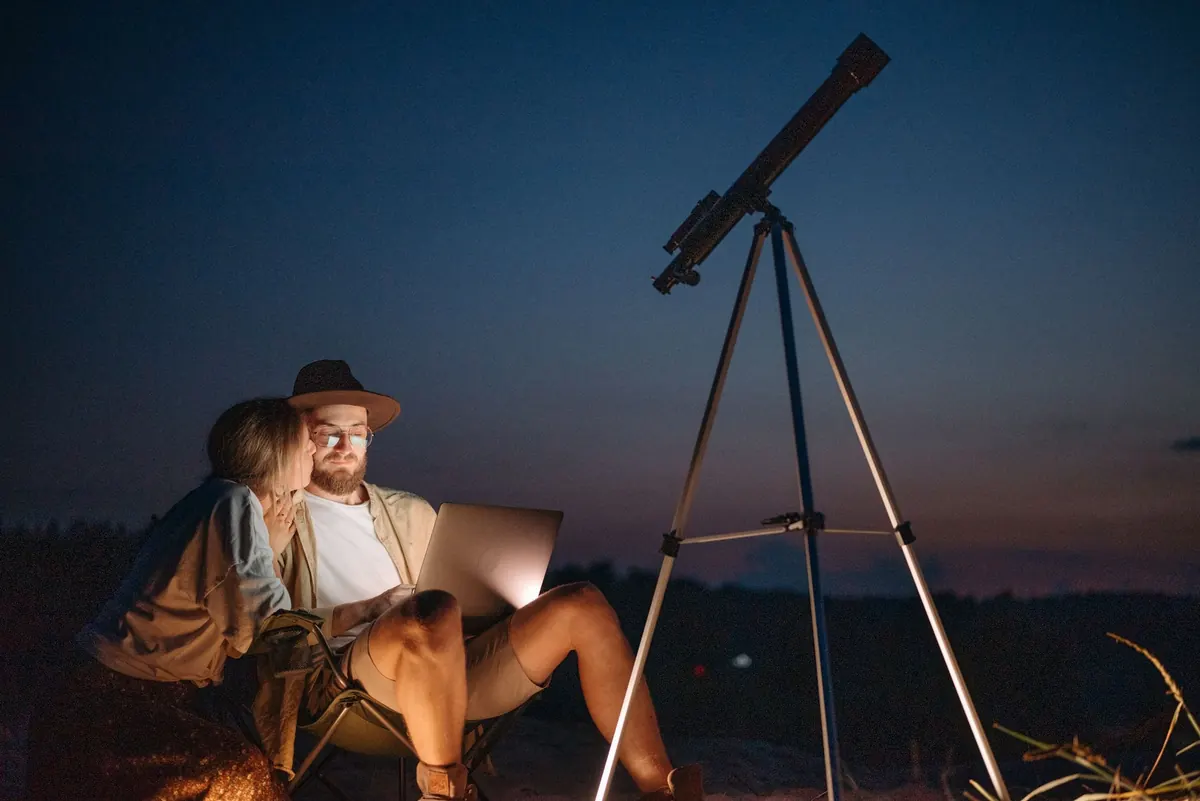
A telescope is one of those purchases that rewards a bit of homework. Choose well and you will spend years tracing the Moon's craters, splitting double stars and watching Jupiter's moons shuffle position from night to night. Choose badly and the thing ends up at the back of a cupboard by February. The difference rarely comes down to price alone. It comes down to understanding four things: aperture, mount, eyepieces and the sky above your own street.
Start with aperture, not magnification
Aperture is the diameter of the telescope's main lens or mirror, and it decides how much light you collect. More light means fainter objects and finer detail. It is the one specification worth paying attention to.
Magnification is different. You can change it with any eyepiece, and it is the number printed in the largest font on the boxes of the worst telescopes. A scope advertised at 600x is not a bargain; it is a warning sign. A useful rule of thumb is that the maximum magnification a telescope can usefully deliver is roughly twice its aperture in millimetres. A 130mm scope therefore tops out near 260x, and only on a night when the atmosphere is unusually steady. On most UK nights, 100x to 150x is far more realistic, and the view will be better for it.
Refractor, reflector or Maksutov?
There are three basic designs, and each suits a different kind of beginner.
Refractors
These use a lens at the front and never need adjusting. Small ones are rugged, quick to set up and excellent for the Moon, planets and double stars. The catch is cost: aperture gets expensive quickly, so a refractor of 80mm to 100mm is a sensible ceiling for most first purchases. Avoid the very cheap 60mm models sold on flimsy tripods — they are the classic disappointment.
Newtonian reflectors
A mirror at the bottom of an open tube, with a small secondary mirror near the top. Pound for pound, this is the most aperture you can buy. A 130mm or 150mm Newtonian is the standard recommendation for a beginner, and it will show globular clusters, the Orion Nebula and the rings of Saturn on a good night. It needs occasional collimation — aligning the mirrors — which sounds intimidating and takes about ten minutes once you have practised.
Maksutov-Cassegrains and Schmidt-Cassegrains
Compact, sealed tubes that fold a long focal length into a short body. They are superb on the Moon and planets and easy to store in a small flat. Their narrow field of view makes them less suited to sweeping the Milky Way, and they are more expensive per millimetre of aperture.
The mount matters as much as the optics
A brilliant telescope on a wobbly tripod is a bad telescope. Every touch sends the image dancing, and you will give up long before you see anything worthwhile.
Two families of mount matter here. Alt-az mounts move up and down and side to side, which is intuitive and fine for visual observing. Equatorial mounts track the sky by turning on one axis, which is useful for photography but confusing when you are still learning where things are. If you buy a Newtonian, consider a Dobsonian base: a simple, rock-steady alt-az cradle that puts your money into the mirror rather than the mechanics.
GoTo mounts find objects for you after a short alignment routine. They are genuinely helpful in a light-polluted town, but they add cost and batteries, and they teach you less about the sky. A reasonable compromise for a beginner is a manual mount plus a good star chart or phone app.
Eyepieces: two good ones beat six poor ones
Magnification is simply the telescope's focal length divided by the eyepiece's focal length. A 1000mm scope with a 25mm eyepiece gives 40x; swap in a 10mm eyepiece and you get 100x.
Most starter scopes come with one or two basic eyepieces, usually Plössls of around 25mm and 10mm. That pairing covers a lot of ground. If you buy anything extra, a 2x Barlow lens doubles the magnification of whatever you already own and is often more useful than a third eyepiece. Skip the large eyepiece and filter kits — you will use two of the pieces and ignore the rest. If you wear glasses, check the eye relief before buying anything with a short focal length.
Light pollution: what a UK garden can actually show you
This is where expectations meet reality. Astronomers use the Bortle scale, running from 1 (pristine dark sky) to 9 (inner city). A suburban street is rarely better than the middle of that scale, and the effect is dramatic: faint galaxies and nebulae that look superb from a dark site become invisible from a lit back garden.
The good news is that plenty of targets shrug off light pollution entirely:
- The Moon — endlessly detailed, and best observed when it is not full
- Jupiter and Saturn, along with their moons and rings
- Venus and Mars during favourable apparitions
- Double stars such as Albireo and Mizar
- Bright open clusters, including the Pleiades and the Beehive
- The Orion Nebula, which still shows shape from a town
If you want the deep-sky experience, plan trips. The UK has certified dark sky places including Kielder Forest, Galloway Forest Park, Exmoor and Bannau Brycheiniog, and even a nearby village with no street lighting is a big improvement. Closer to home, turn off garden lights, shield the ones you cannot switch off, and give your eyes twenty minutes to adapt — then protect that dark adaptation with a red torch.
Buying new, used, or not yet
Second-hand telescopes are excellent value because so many are barely used. Buy from an astronomy society member if you can, and check the mirror or lens for scratches, mould and dust before handing over money. Ask to look through it in daylight at a distant object; if the image is sharp and the focuser moves smoothly, that is a good sign.
Red flags to walk away from:
- Magnification claims above roughly twice the aperture in millimetres
- Thin, spindly tripods with plastic fittings
- 0.965-inch eyepieces, an obsolete size still fitted to toy scopes
- No brand name, no manual and no way to fit standard accessories
- Sellers who will not let you inspect it first
Joining a local astronomy society costs very little and often gives you access to loan telescopes, dark-sky trips and people who will happily let you try before you buy. It is the cheapest upgrade available.
Your first night out
Set the telescope up in daylight so you are not fumbling with bolts in the dark. Let a Newtonian cool for twenty to thirty minutes — a warm mirror gives mushy images. Start with your lowest magnification eyepiece, point at the Moon if it is up, and focus slowly. Once that works, move to a bright star and then to Jupiter or Saturn. Keep a chair handy, dress warmer than you think you need to, and stop when you get cold rather than pushing on. Astronomy in Britain is a patience game, and the nights that reward you are worth waiting for.
Photo: Pavel Danilyuk / Pexels